
In summary
- There is no price per extension. The cost is divided into central, terminals, installation, traffic and maintenance — and proposals rarely separate the five components.
- Year-on-year comparisons are always misleading. On-premise and cloud solutions typically cross paths between the third and fifth year.
- In per-user models, the bill grows with the hirings without anyone making a new decision.
- The most frequent hidden cost is oversizing of simultaneous channels.
In this article
“How much does a telephone system cost?” is a question without a useful answer, for the same reason that “how much does a car cost” doesn't have one. But there is a cost structure that always repeats itself, and knowing it allows you to read proposals with different eyes.
The five cost components
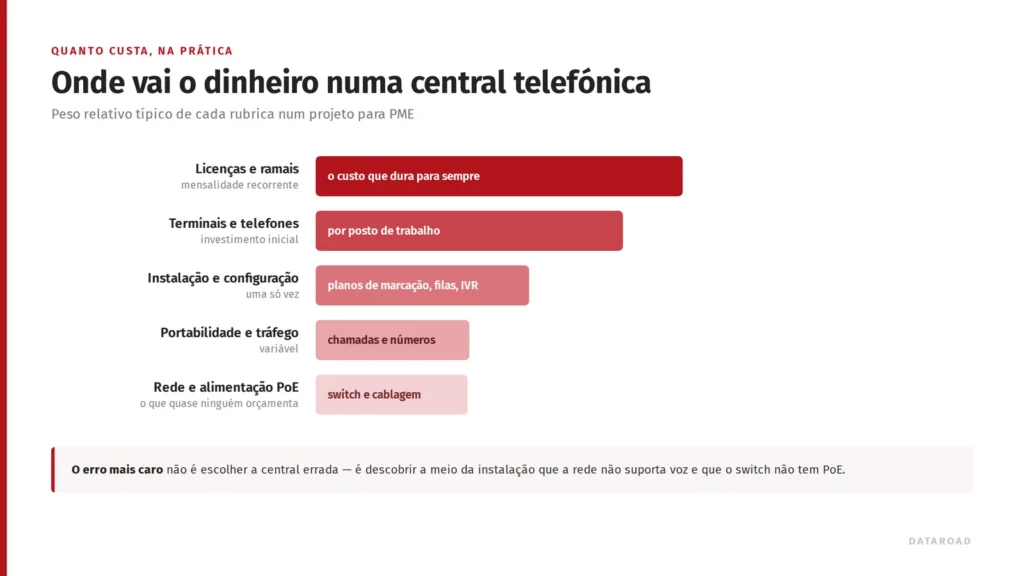
Regardless of the solution, the total invoice is always broken down into the same five parts:
- A central — licensing or subscription, normally per extension or per simultaneous call.
- The terminals — IP phones, headsets, computer and mobile applications.
- The installation — configuration, numbering plan, messages, opening hours, number portability.
- The traffic - what is paid to the operator for calls and the SIP trunk.
- Maintenance — updates, support and changes over time.
Many proposals present only two or three of these items, which makes comparison with another proposal impossible without additional work.
Always ask for the five separate instalments. A proposal that bundles everything into a single monthly fee could be brilliant or terrible — there's no way of knowing without breaking it down. And a supplier that resists separating them is telling you something.
What factors weigh into a custom solution
In an on-premise system, the investment is concentrated at the beginning.
O licensing It typically scales with the number of extensions, but what usually comes as a surprise is the cost of additional modules — call recording, call queues, CRM integration, reporting. They are almost always extra.
The telephones They are the most underestimated part. The difference between a basic model and one with a screen and supervisor keys seems small until it is multiplied across thirty stations.
A Installation It varies greatly with the complexity of the numbering plan. A company with simple customer service gets set up quickly; one with queues by department, varied schedules and overflow to mobile phones requires real configuration work.
A annual maintenance it's the item that most often disappears from proposals — and the one that ensures the control panel receives security updates.
What weighs in on a cloud solution
Here the logic is reversed: smooth entry, constant cost.
A user fee dominates everything else. It is what makes the solution affordable in the first year and what makes it expensive in the fifth, especially if the team grows.
It is worth understanding what this monthly fee includes: how many simultaneous calls per user, whether national calls are included, if call recording is a paid option, and how many devices each person can use at the same time.
A Portability usually has a one-off cost, and the minimum contract period that is where the differences between seemingly identical proposals are hidden.
How to compare proposals
The only honest comparison is made to three to five years, and with an explicit growth scenario.
Build a table with the cumulative cost of each option at the end of one, three and five years, assuming the number of people you expect to have at each point in time. The result is usually counter-intuitive: solutions that seemed expensive win, and vice versa.
Two typical scenarios. A stable company, with a single office and twenty to forty workstations, tends to pay less with an on-premises solution from the fourth year onwards. A growing company, with multiple locations or many mobile workers, rarely regrets the cloud — the extra cost buys flexibility that the other option cannot provide.
Hidden costs
Too many simultaneous channels. It is the most common waste in business telephony. Outside of intensive customer service contexts, a team of thirty people rarely needs more than eight to ten channels. Sizing by the number of employees instead of actual traffic costs money every month.
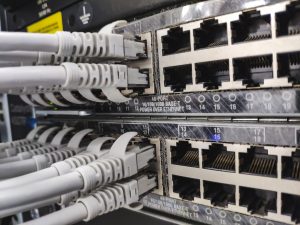
The network that is going to have to improve. If the internal network does not prioritise voice, the new switchboard will give poor calls — and the true bill includes intervention in the structured network.
Back-up power supply. IP phones rely on switches, which rely on power. Without a UPS, a power failure leaves the business unreachable.
Traffic fraud. A poorly protected PBX exposed to the internet can generate thousands of euros in international calls in a single weekend. It is a cost that does not appear in any proposal and can be avoided with adequate security configuration and destination limits.
DataRoad installs and manages IP PBX telephone systems for businesses, on-premise or in the cloud, with proposals broken down item by item to make comparison possible.
A chat before making a decision
Whether you’re tackling a specific problem, planning a move or simply looking for a second opinion, we always start in the same way: by understanding your situation before making any suggestions. No obligation, no jargon and no catalogues.