
In summary
- PBX and PABX are the same thing. The real decision is between having the PBX on your premises or hosted by a supplier.
- Five questions decide the choice: number of locations, people out of the office, internet quality, simultaneous calls and required integrations.
- Comparing costs over one year leads to the wrong decision. The useful comparison is made over three to five years, taking the team's growth into account.
- The most expensive mistake is rarely in the headquarters — it's in the network that supports it.
In this article
Few infrastructure decisions generate as much confusion as choosing a telephone system. The blame lies partly with the vocabulary: PABX, PBX, IP PBX, VoIP, SIP trunk, hosted PBX. Some of these terms are the same thing under different names, and vendors rarely help to clear things up.
Vocabulary, sorted
PBX it is a company's private telephone exchange — the system that routes calls between extensions and to the outside world. PABX add “automatic”, as opposed to the old operator exchanges. Since manual exchanges no longer exist, PBX and PABX mean exactly the same thing. If a supplier charges more for a PABX, they are selling you a pup.
IP PBX It is a switchboard that routes calls over a data network instead of traditional lines. VoIP it is the underlying technology, not a product. SIP trunk it's the trunk line to the operator, which replaces the physical lines. Hosted or cloud-based phone system It is a cloud-based IP PBX hosted on a provider's servers and paid for by subscription.
The three possible architectures
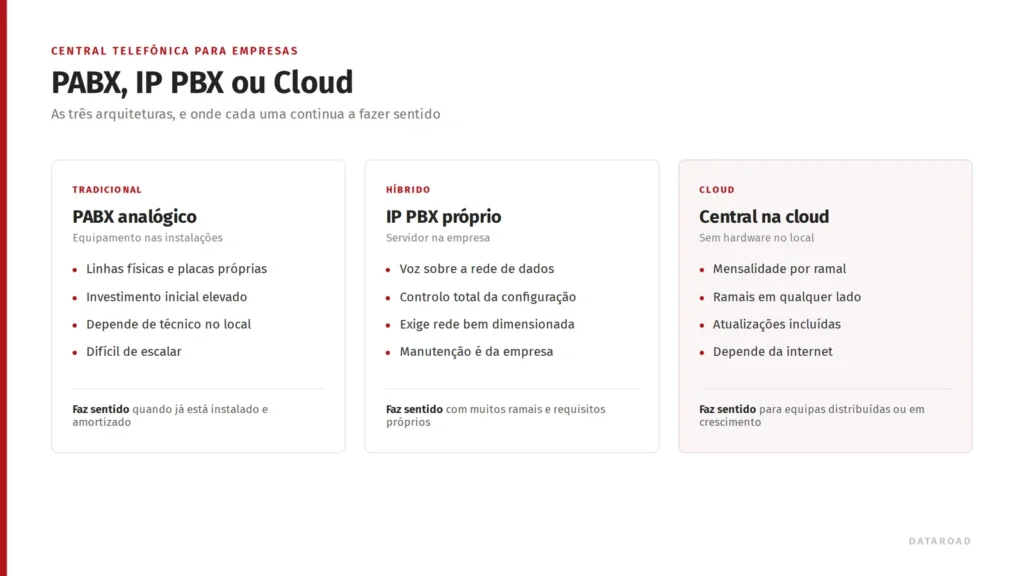
Physical control unit on site. It still makes sense when there are many analogue phones to maintain, when the internet is unreliable and the phone cannot depend on it, or when there are requirements demanding that communication does not leave the building. In return, it has the highest initial investment and is aging.
In-house IP PBX on a server. The control unit is software, on a company machine. It combines control and flexibility — adding extensions is a matter of configuration, not buying cards. It requires someone to keep it up to date.
Cloud hub. Everything is hosted on the supplier's side, paid per user. It is the natural choice for businesses with multiple locations or many people working remotely. The trade-off is total reliance on the internet and the recurring cost.
Five questions that decide
- How many locations? With one office, either option works. From two onwards, the cloud gains a clear advantage.
- How many people are out of the office? If it is significant, the decision is practically made.
- How is the internet quality? Voice over IP does not need a lot of bandwidth, but it is very sensitive to latency variation and packet loss.
- How many simultaneous calls? Almost all companies overestimate. A team of thirty people rarely needs more than eight to ten channels.
- Which integrations? Identifying the customer in the CRM, recording calls, service queues — this narrows down the options significantly and should enter the conversation before the price.
Measure your internet connection before deciding on the cloud. A connection that works well for email and web browsing can suffer from choppy calls during peak hours. And it is wise to have a backup connection: if the internet goes down and the phone system is in the cloud, the company is left without phones.
How much is it
There is no single price because there is no single product, but the cost structure is repeated.
In-house solution: extension, server or equipment licensing, IP phones, installation and numbering plan, annual maintenance, and the SIP trunk with traffic.
Cloud solution: per-user subscription — the dominant cost —, handsets, initial setup with number portability, and traffic.
An honest comparison is made over three to five years. An on-premise solution has an initial investment that scares people off and low running costs; the cloud has a gentle entry and a constant cost. A company that grows quickly rarely regrets choosing the cloud; a stable company with a single office usually pays less with an on-premise solution after four or five years.
A detail that weighs heavily and goes unnoticed: in per-user models, anyone who grows from 30 to 60 people doubles their telephony bill without having made any new decisions.
Migrate without stopping service
The biggest concern for anyone switching switchboards is not technical — it's not missing calls. It's legitimate and manageable.
A number portability it is the slow part: there are statutory deadlines and it depends on the losing provider, so it dictates the entire schedule and must be started early. The method that works is keep the two control panels in parallel over a period — a test number is diverted, the quality is validated, the team is trained, and only then are the main numbers migrated.
And don't migrate on a Friday. A problem detected on a Friday afternoon lives all weekend.
Take advantage of the migration to rethink the numbering plan. It is the only time you can review who answers first, what happens outside of business hours and where an unanswered call goes at no additional cost. It is worth more than any feature in the catalogue.
Frequent errors
- Choose from the feature list. All modern power stations have dozens; most companies use five.
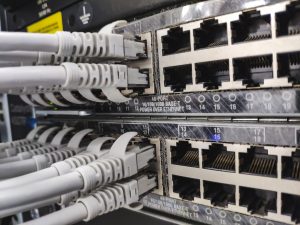
- Ignore the internal network. An excellent switchboard in a saturated network gives poor calls. It is frequent that the solution to “telephony is poor” lies in structured network and not in the call centre.
- Forget the power supply. Without a UPS, a power failure leaves the business uncontactable — something traditional switchboards never did.
- Do not test out-of-hours behaviour. Many companies discover months later that nighttime calls were ringing out to an empty office.
- Leave the control panel exposed. Poorly configured telephone systems accessible via the internet are frequent targets of traffic fraud, and the financial damage shows up on the next bill. They should be behind proper firewall rules.
DataRoad installs and manages IP PBX telephone systems for businesses, on-premises or in the cloud, including number portability and integration with the existing infrastructure.
A chat before making a decision
Whether you’re tackling a specific problem, planning a move or simply looking for a second opinion, we always start in the same way: by understanding your situation before making any suggestions. No obligation, no jargon and no catalogues.