3-minute read DataRoad
In summary
- The operator's router was designed for a family, not for a company.
- From 8-10 users, the symptoms appear: slowness, breakups, short range.
- The difference is not just speed — it is security, separate networks and someone in charge.
- Migrating to an enterprise network is a small investment considering what the company loses without him.
In this article
A piece of equipment designed for a family
The router the operator installs is an excellent machine — for the purpose for which it is intended: a home, half a dozen devices, watching series in the evening. A business is another world: dozens of devices connected at the same time, simultaneous video calls, cloud billing, printers, IP phones and visitors asking for the password. Asking that of a home router is asking an estate car to do the job of a lorry.
The signs that the company has outgrown the router
It is always the same: the network slows down when “everyone is there”; video calls drop out; there are rooms with no signal; the Wi-Fi password has been the same for three years and half the neighbourhood has it; and when something goes wrong, the solution is the ritual of turning it off and on again. Each of these symptoms has a silent cost in team time — and a security risk that grows with every visitor who has connected to the network where the billing lives.
What changes in a business network
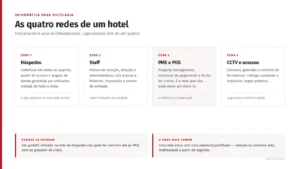
Four things, all with a direct impact on the business. CapacityProfessional equipment can handle dozens of concurrent users without degrading. Separate networksteam, guests and equipment, each to their own — visitors never touch company data. Managed securityupdates, password rules and visibility of who is logged in. And someone responsiblewhen something fails, there is a team already sorting it out — not a generic operator support number.
How to make the transition without stopping the business
The operator's internet remains — that part is fine. The distribution is replaced: the DataRoad installs the professional equipment, configures the networks and migrates the devices, typically in a day and without interrupting work. From then on, the network is managed and monitored — and the operator's router goes back to doing just what it has always known how to do: bringing the internet to the front door. Get in touch with us and tell us how many people you have — we'll tell you what your network should be.
A chat before making a decision
Whether you’re tackling a specific problem, planning a move or simply looking for a second opinion, we always start in the same way: by understanding your situation before making any suggestions. No obligation, no jargon and no catalogues.
DataRoad Blog Articles
- Wi-Fi 6, 6E or Wi-Fi 7? A Plain-Language Guide for Decision-Makers
- Wi-Fi in Warehouses and Industrial Premises: Coverage Where the Work Takes Place
- Wi-Fi for the Hybrid Office: Smooth Video Calls, Meetings Without Embarrassment
- FREE NOW: corporate IT network and Wi-Fi in Lisbon