4 min read DataRoad
In summary
- Wi-Fi is today a hotel's most reviewed service — appears in reviews before breakfast.
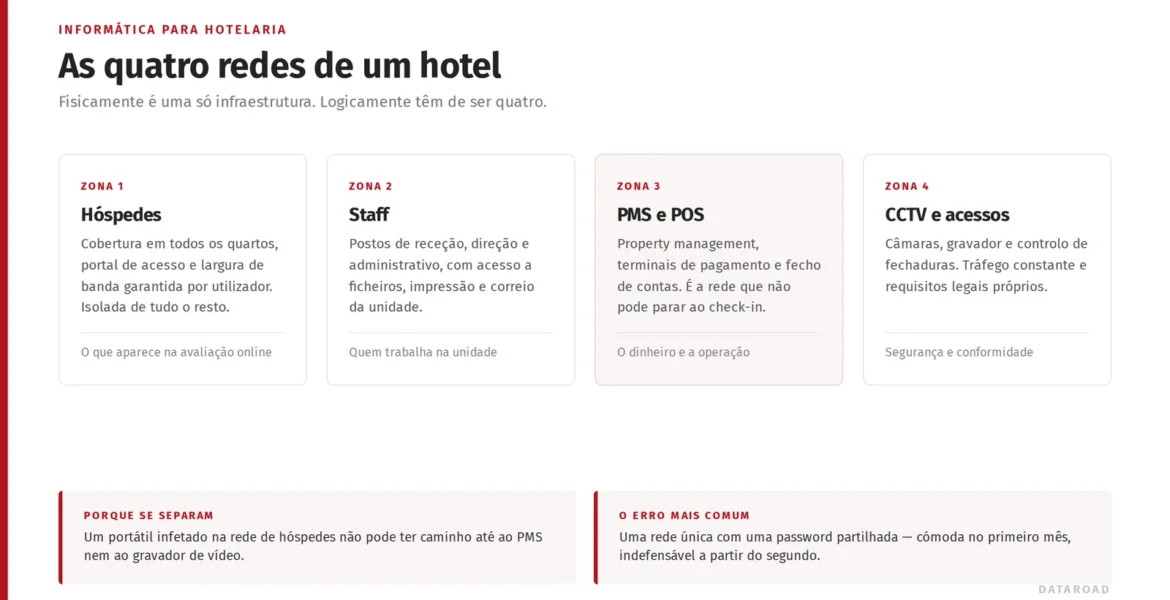
- A hotel needs at least four separate networksguests, operation, events and equipment.
- The problem is rarely the internet you're paying for — it's the poorly designed internal network.
- With a managed network, the hotel stop listening to complaints at reception — and DataRoad resolves it before the guest even notices.
In this article
Wi-Fi gets into the reviews — for better and for worse
A guest forgives a lot. A firmer pillow, a slow lift. What they do not forgive is being unable to make a work video call in their room, or watching their evening series with interruptions. And when that happens, they write a review — on Booking, Google, TripAdvisor. Wi-Fi has become just as real a criterion for choosing a hotel as location. The good news: it works the other way around too. “Excellent internet throughout the hotel” is one of the most common phrases in 9 and 10 ratings.
The four networks of a well-run hotel
In a professional hotel, Wi-Fi isn't just one network — it's at least four, separate and secure:
- Guest network — fast, simple to use, isolated from everything else. Guest 204 must never be able to “see” the reception computer.
- Operational network — reception, management, PMS and invoicing. It is the heart of the hotel and lives protected.
- Events and function rooms network — for conferences and groups, with dedicated capacity that does not steal speed from the rooms.
- Equipment network — cameras, electronic locks, TVs and home automation, increasingly present and increasingly targeted by attacks.
We set up this exact architecture in units such as the LX Arch Hotel, on Rua Augusta in Lisbon — Wi-Fi 7, CCTV and full IT management.
Why hotel Wi-Fi fails
It is almost never the contracted internet. It is the thick walls of old buildings, domestic equipment doing professional work, and networks that have grown in a piecemeal fashion — a router here, a repeater there. The result: dead zones in the back bedrooms, dropouts when walking from the lobby to the bar, and a reception team turned into a technical support line. The solution always starts with a site coverage surveyto measure, room by room, where the signal reaches and where it dies — and to design the network based on the reality of the building.
How DataRoad sets up hotel Wi-Fi
We work with hospitality for years and the process is always the same: coverage study in the building, design with the networks separated, installation of professional equipment carried out without disturbing guests, and continuous management — we monitor the network 24/7 and resolve issues before they appear in reviews. For hotel management, this translates into one simple thing: Wi-Fi is no longer an issue.
A chat before making a decision
Whether you’re tackling a specific problem, planning a move or simply looking for a second opinion, we always start in the same way: by understanding your situation before making any suggestions. No obligation, no jargon and no catalogues.